 David Feng
Notes on Bach's Music (1/N)
(Translated from the Chinese version with the help of ChatGPT.)
Johann Sebastian Bach (1685–1750) was the great synthesizer of Baroque music and a perennial candidate for the GOAT of classical composers. His works span an enormous range of genres and are remarkable both in quantity and quality.
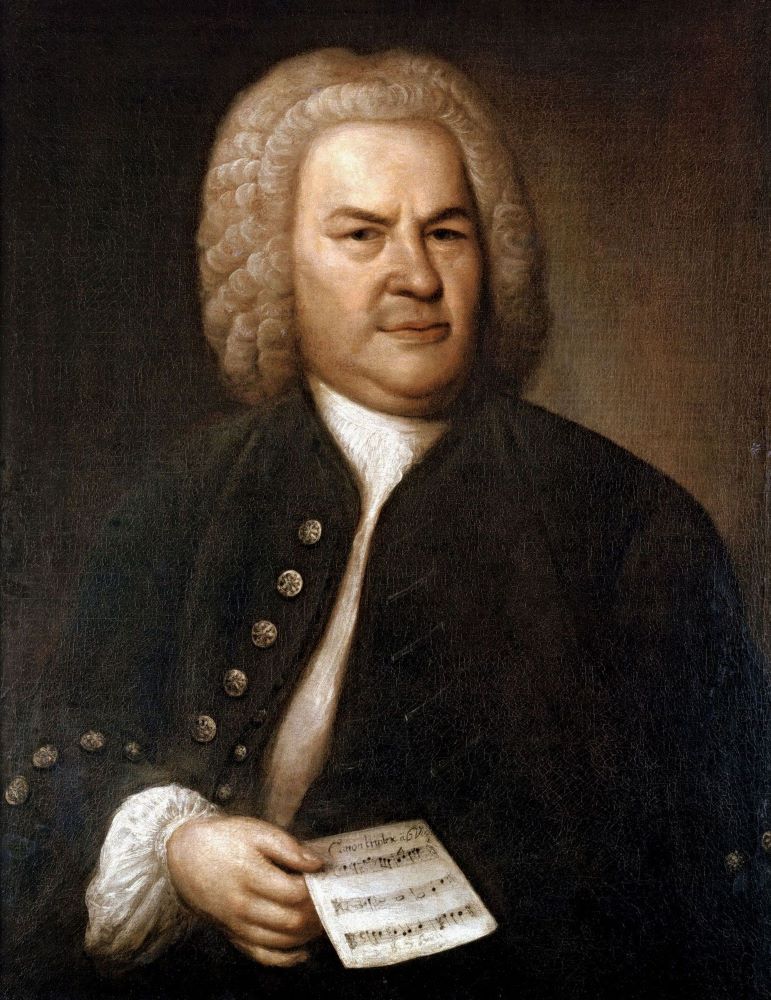
Bach
My earliest impressions of Bach came from two places. First was the video game Civilization IV: when your civilization advances from the Middle Ages into the Renaissance, the background music suddenly evolves from slow Gregorian-style chant into rich Baroque music—it feels fantastic. When I looked it up, I discovered that most of those tracks were written by Bach. The second was Douglas Hofstadter’s Gödel, Escher, Bach: An Eternal Golden Braid (GEB).
But only recently did I decide to listen to Bach’s works in a somewhat systematic way. At first I planned to just sample a few pieces and write a short summary—after all, sharing enjoyment is better than enjoying alone. But Bach has too many great works. It feels like discovering a cave full of treasure: you intend to explore just a little and come back to report to everyone, but the deeper you go, the more treasures you find. “Oh, this is great… wait, that one is also amazing… let me check one more thing…” After procrastinating for quite a while, I finally forced myself to stop. Done is better than perfect—otherwise this report would never be finished.
Categories of Works
Bach’s compositions are usually identified by BWV numbers. In the Bach333 complete edition (released in 2018 for the 333rd anniversary of Bach’s birth), his works are divided into four categories:
- Sacred cantatas1
- Sacred and secular vocal works (secular cantatas, passions, masses, chorales, etc.)
- Organ and keyboard works (e.g., the Goldberg Variations)
- Instrumental works (e.g., concertos)
Simply put, categories 1–2 involve singing (usually in German), while 3–4 are purely instrumental. Within these broad groups, sacred cantatas and organ/keyboard works are often singled out.
But the boundaries are not rigid. Bach’s works were frequently rearranged by later musicians. Below, for example, are two cantatas that were later adapted into piano pieces. The original versions and the arrangements each have their own charm. I don’t understand the German lyrics in the originals, and sometimes the combination of voices and multiple instruments can feel a bit dense. In piano arrangements, those “issues” disappear. On the other hand, looking up translations of the lyrics can provide extra insight into the music, and the contrast between different instrumental timbres (including the human voice) adds another dimension to appreciation.
Even with the same piece and the same instrumentation, different conductors, orchestras, and singers—and even the same performer at different stages of their career—can produce quite different tempos, moods, and interpretations. Sometimes the differences are dramatic. If you’re interested, it’s worth listening to multiple versions—you might discover some pleasant surprises.
Bach’s Life2
Bach’s career can roughly be divided into three periods: Weimar, Köthen, and Leipzig.
Weimar (1708–1717): The golden age of his organ music, along with early cantatas and a small number of instrumental works.
Köthen (1717–1723): His employer did not require church cantatas, so Bach composed a large amount of secular instrumental music, including the Brandenburg Concertos and The Well-Tempered Clavier.
Leipzig (1723–1750): In the early years he produced many sacred cantatas and several passions. After around 1740, Bach began summarizing and refining his compositional techniques, producing masterpieces such as the Goldberg Variations, The Art of Fugue, The Musical Offering, and the Mass in B Minor. These works elevated his historical stature to an entirely new level.
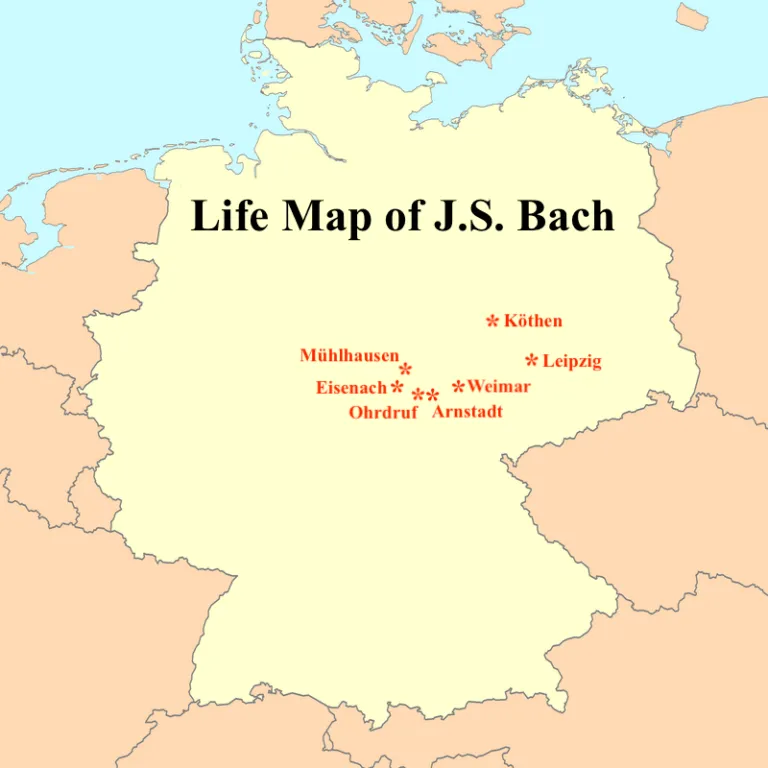
Places Bach Lived and Worked
BWV 208/9
Enough background—let’s start listening.
BWV 208, Was mir behagt, ist nur die muntre Jagd (“The lively hunt is all my heart’s desire”), commonly known as the Hunting Cantata, is the earliest surviving secular cantata by Bach. It was composed in 1713 during his Weimar period as a birthday gift from the Duke of Weimar to a neighboring duke who loved hunting.
The most famous movement is the soprano aria in No. 9: Schafe können sicher weiden (“Sheep May Safely Graze”). The melody is beautiful: two flutes and strings create a serene pastoral atmosphere. The lyrics were written by a court poet in Weimar and compare good governance to shepherding and hunting—essentially a flattering piece of political praise.
Bach must have been quite satisfied with the work, because he later recycled it several times for other aristocratic birthday celebrations—just change the name and reuse it! But honestly, with such an excellent piece, performing it only once for a single birthday celebration—before the age of recordings—would indeed have been a waste. I fully support the recycling.
Lyrics (German / English)
Schafe können sicher weiden / Sheep can safely graze
Wo ein guter Hirte wacht. / where a good shepherd watches over them.
Wo Regenten wohl regieren / Where rulers are ruling well,
Kann man Ruh’ und Friede spüren / we may feel peace and rest
Und was Länder glücklich macht. / and what makes countries happy.
Original Version
Piano Version
Performed by Lang Lang and Gina Alice:
BWV 147/10
BWV 147 is a sacred cantata titled Herz und Mund und Tat und Leben (“Heart and mouth and deed and life”). Its most famous movement is the chorale Jesus bleibet meine Freude (“Jesu, Joy of Man’s Desiring”).
There is also an interesting story behind its composition. On December 1, 1716, Bach’s boss in Weimar died. Both Bach and many others believed that, based on his ability and contributions, he would naturally succeed to the position. Bach entered an intense burst of productivity, composing cantatas one after another to demonstrate his abilities—including an early version of this work, BWV 147a.
But the result was shocking: the deceased boss’s son—an obscure figure—was appointed instead. Bach was furious and resigned in protest. After a period of negotiation and conflict with his employers—and even spending a month in jail—he was finally allowed to leave and moved to Köthen. Later, after arriving in Leipzig in 1723, Bach revisited the piece and expanded it into the version we know today.
Lyrics (German / English)
Jesus bleibet meine Freude, / Jesus remains my joy,
Meines Herzens Trost und Saft, / My heart’s comfort and strength,
Jesus wehret allem Leide, / Jesus protects against all suffering,
Er ist meines Lebens Kraft, / He is the strength of my life,
Meiner Augen Lust und Sonne, / My eyes’ joy and sun,
Meiner Seele Schatz und Wonne; / My soul’s treasure and delight;
Darum laß ich Jesum nicht / Therefore I will not let Jesus
Aus dem Herzen und Gesicht. / Out of my heart and my sight.
Original Version
Piano Version
Conclusion: Just Getting Started
Trying to do too much at once leads to shallow understanding. Sustainable progress is better. So today we’ll stop after these two appetizers.
I must have heard both of these pieces before (probably at weddings), but only this time did I realize: “Wow—these are by Bach!” I expect many more moments of surprise like this in the future. Stay tuned!
-
A cantata is a vocal composition without stage performance (such as dramatic action, costumes, or scenery). Structurally it resembles opera but is shorter (usually around 20–30 minutes). It typically consists of recitatives (narrative passages), arias (expressing emotion), and choruses (often at the beginning and end, with memorable melodies). Cantatas were commonly used in church services or secular celebrations. ↩︎
-
There is a humorous Chinese biography of Bach titled Accidentally Becoming Bach written by Hutou, notable for its playful translations of names and places. The BBC also produced a documentary on Bach’s life, presented by the renowned Bach conductor Sir John Eliot Gardiner, which is well worth watching. My main impressions after watching it: Bach was clearly a genius, but he also genuinely loved music and worked extremely hard. His appointment in Leipzig happened largely because five other candidates had already declined the offer. The hiring committee’s comment was basically: “Since we cannot get the best, we’ll have to settle for someone adequate.” No one is perfect—Bach was extremely defensive and reluctant to show weakness, often feeling that others were working against him and that any setback must be someone else’s fault (see 1:13:20). This somewhat resembles traits of paranoid personality, possibly related to bullying and mistreatment during his childhood. ↩︎